




Reflecting on SEL Day: Building Global Citizens at Operation Xcel
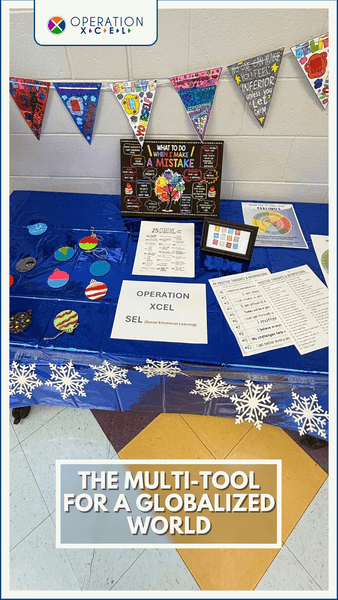
Yesterday, we joined educators and advocates worldwide to celebrate International SEL Day. At Operation Xcel, every day is an opportunity to practice the social-emotional skills that transform students into resilient, empathetic global citizens.
Social-emotional learning (SEL) is a transformative process that equips individuals with the essential skills needed to understand and regulate their emotions, set personal goals, and make thoughtful, responsible decisions. While these skills are pivotal for academic success, they are equally vital for professional endeavors and personal relationships in an increasingly complex world.
The Science of the "Head Start"
For our K–8 students, an early start in SEL is a lifelong competitive advantage. A landmark longitudinal study tracked kindergarteners for 20 years and found that those with high social-emotional scores were statistically more likely to graduate from college and hold full-time jobs by age 25 (Jones, Greenberg, & Crowley, 2015).
Furthermore, a massive meta-analysis of 213 school-based programs demonstrated that students receiving SEL instruction showed an 11-percentile-point gain in academic achievement (Durlak et al., 2011). By starting in K-8, we aren't just helping kids "behave"—we are ensuring their future economic and personal stability.
Navigating a Diverse, Globalized World
In a globalized society, the ability to work across cultures is no longer optional. Research highlights that "Global Competence" is built directly upon the CASEL pillars of Social Awareness and Relationship Skills (OECD, 2018).
- Perspective-Taking: Individuals with high self-awareness are better able to recognize their own cultural biases, allowing them to collaborate more effectively with people from diverse backgrounds (Banks, 2015).
- The Future of Work: The modern labor market increasingly rewards "soft skills." Research indicates that nearly all job growth in the U.S. since 1980 has occurred in occupations requiring high levels of social interaction (Deming, 2017).
The CASEL Framework: A Roadmap for All Ages
Operation Xcel utilizes the five interconnected groups of skills introduced by the Collaborative for Academic, Social, and Emotional Learning (CASEL). These are recognized as "The Future of Work," with emotional intelligence and resilience ranked as top-tier requirements for the global workforce (World Economic Forum, 2023).
- Self-awareness: Recognizing emotions and values.
- Self-management: Regulating impulses and managing stress.
- Social awareness: Demonstrating empathy and respect for others.
- Relationship skills: Creating and maintaining healthy connections.
- Responsible decision-making: Making ethical, positive choices
Expert-Led Mastery at Operation Xcel
At Operation Xcel, SEL is led by a team of dedicated professionals. Ms. Fuller is but one of the many staff who facilitate SEL amongst our students. Ms. Fuller is a certified school counselor; she and our other certified teachers ensure all students learn and—crucially—practice these skills.
During a recent two-week intensive summer program for rising 9th grade students at Jamestown Middle School, Ms. Fuller shared a powerful "emotional hygiene" strategy. As students enter, they write down a negative emotion or distraction they wish to "let go of" on a purple Post-it note and place it in a bin.
This practice of "affect labeling"—putting feelings into words—is scientifically proven to reduce activity in the amygdala (the brain’s emotional center), clearing the "mental runway" for higher-level learning and thoughtful interaction (Lieberman et al., 2007).
Conclusion
As we look back on SEL Day, we are reminded that when children thrive, society becomes stronger. By investing in SEL for our K-8 students today, we are cultivating a generation of adults who can lead with empathy, decide with ethics, and thrive in an ever-changing global landscape.
References
- Banks, J. A. (2015). Cultural Diversity and Education: Foundations, Curriculum, and Teaching. Routledge.
- Deming, D. J. (2017). The Growing Importance of Social Skills in the Labor Market. The Quarterly Journal of Economics, 132(4), 1593–1640.
- Durlak, J. A., Weissberg, R. P., Dymnicki, A. B., Taylor, R. D., & Schellinger, K. B. (2011). The Impact of Enhancing Students’ Social and Emotional Learning: A Meta-Analysis. Child Development, 82(1), 405–432.
- Jones, D. E., Greenberg, M., & Crowley, M. (2015). Early Social-Emotional Functioning and Public Health. American Journal of Public Health, 105(11), 2283–2290.
- Lieberman, M. D., et al. (2007). Putting Feelings Into Words: Affect Labeling Disrupts Amygdala Reactivity. Psychological Science, 18(5), 421–428.
- OECD (2018). Preparing our Youth for an Inclusive and Sustainable World: The OECD PISA Global Competence Framework.
- World Economic Forum (2023). The Future of Jobs Report 2023.
