




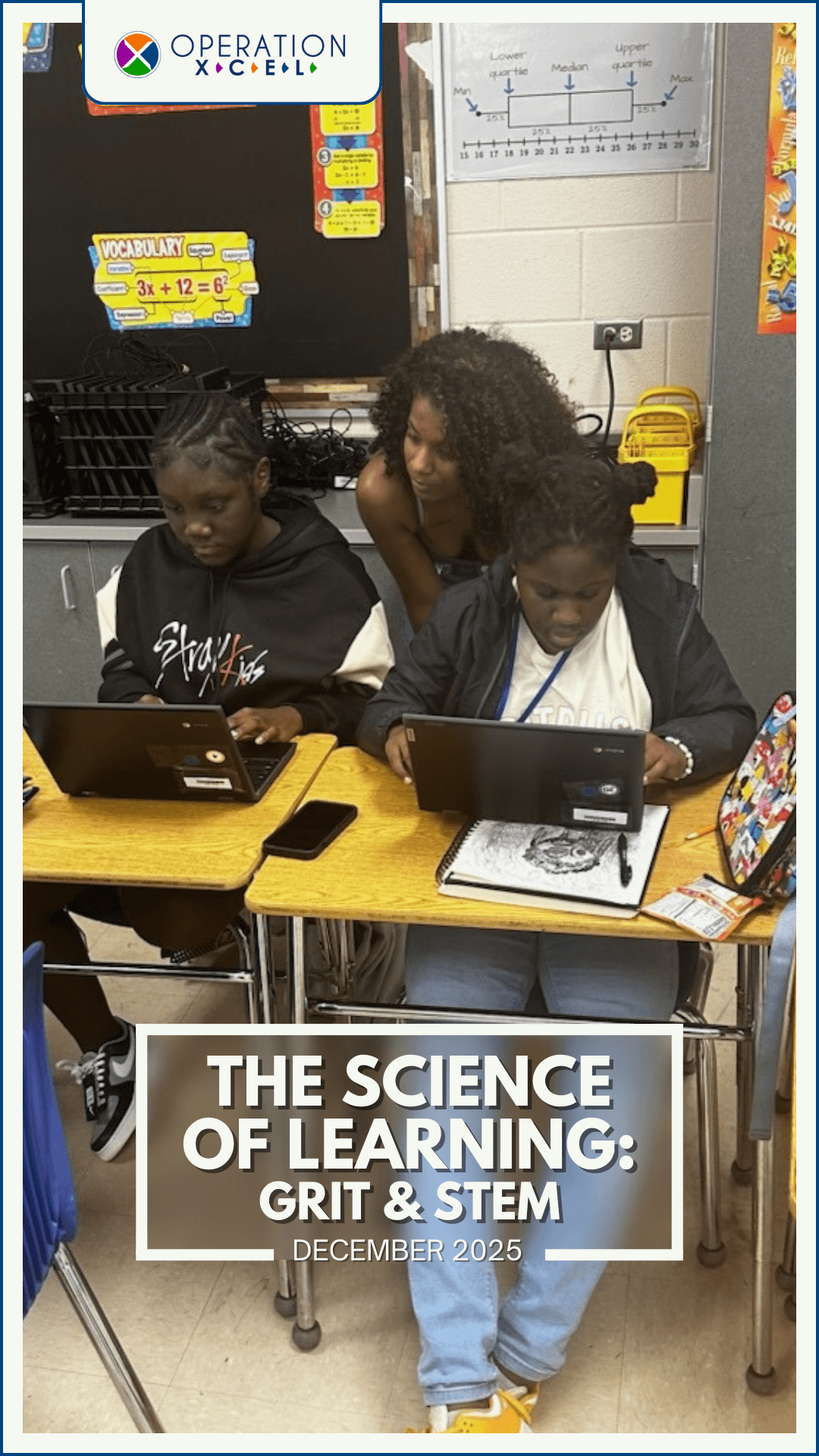
At Operation Xcel, we don't just teach subjects; we cultivate mindsets. Our approach utilizes proven pedagogical strategies—including Personalized Learning Plans (PLPs) and multi-modal assessment of learning styles—to ensure every student is met where they are.
However, the "secret sauce" of our curriculum lies in the intentional integration of GRIT (Growth, Resilience, Integrity, and Tenacity) within STEM education. Research shows that while talent is a starting point, it is perseverance that determines the finish line (Duckworth et al., 2007).
Why GRIT Matters: The Data Behind the Determination
GRIT, a term popularized by psychologist Angela Duckworth, is defined as passion and sustained persistence applied toward long-term goals. According to research, GRIT is often a more reliable predictor of success than IQ or raw talent, particularly in challenging academic environments (Duckworth, 2016). In the context of STEM—fields characterized by high failure rates in experimentation—GRIT is the bridge between a student's initial curiosity and their eventual mastery.
The Intersection of GRIT and STEM: 7 Pillars of Excellence
1. Cultivating the Growth Mindset
Drawing on the work of Stanford’s Dr. Carol Dweck, our curriculum promotes the belief that intelligence isn't fixed. By praising effort over "natural ability," we help students embrace the "Power of Yet" (Dweck, 2006). This mindset shifts the focus from performance to mastery, a core component of GRIT.
2. Resilience Through Iterative Failure
In STEM, the first attempt is rarely the final one. We teach students that failure is data. This aligns with the Engineering Design Process (EDP), where "Redesign" is a critical, celebrated step that requires immense GRIT (National Research Council, 2012).
3. Real-World Problem Solving
The National Science Foundation (NSF) emphasizes that 21st-century workers must be comfortable with "ill-defined problems" (NSF, 2022). By fostering GRIT, we prepare students to stick with these complex, real-world issues where the answer isn't in the back of a textbook.
4. The Collaborative Community
STEM is rarely a solo sport. Integrating GRIT helps students navigate the friction of teamwork. When a group project hits a wall, students with GRIT communicate and adapt rather than giving up (Duckworth, 2016).
5. Strategic Goal Setting and Metacognition
We teach students to break down massive projects into "micro-goals," mirroring the Agile methodology used in high-tech industries. Regular reflection allows students to see their own progress, turning GRIT into a measurable habit.
6. Hands-On Endurance in Enrichment
Our afterschool and summer programs feature "lab" environments like robotics. Data shows that students participating in long-term challenges like FIRST Robotics show significant gains in STEM interest and conflict resolution compared to peers in traditional classrooms (FIRST, 2021).
7. Bridging the Opportunity Gap
Confidence is the greatest barrier to entry for underrepresented groups in STEM. By practicing GRIT, students build "self-efficacy"—the belief in their own ability to succeed (Bandura, 1997). This increased assurance encourages greater participation in STEM fields, promoting essential diversity.
References
Bandura, A. (1997). Self-efficacy: The exercise of control. W. H. Freeman.
Duckworth, A. (2016). Grit: The power of passion and perseverance. Scribner.
Duckworth, A. L., Peterson, C., Matthews, M. D., & Kelly, D. R. (2007). Grit: Perseverance and passion for long-term goals. Journal of Personality and Social
Psychology, 92(6), 1087–1101. https://doi.org/10.1037/0022-3514.92.6.1087
Dweck, C. S. (2006). Mindset: The new psychology of success. Random House.
FIRST. (2021). The impact of FIRST: 2021 annual impact report. https://www.firstinspires.org/about/impact
National Research Council. (2012). A framework for K-12 science education: Practices, crosscutting concepts, and core ideas. The National Academies Press.
https://doi.org/10.17226/13165
National Science Foundation. (2022). The STEM labor force of today: Scientists, engineers, and skilled technical workers. Science & Engineering Indicators.
Deep Dive: The Research Behind GRIT & STEAM
If you’re interested in the studies that inform Operation Xcel’s curriculum, explore these foundational resources:
- The Power of Yet: Mindset: The New Psychology of Success by Dr. Carol S. Dweck. Learn how shifting from "fixed" to "growth" mindsets transforms student achievement.
- The Grit Scale: Grit: The Power of Passion and Perseverance by Angela Duckworth. A look at why tenacity is a better predictor of success than IQ.
- Engineering the Future: A Framework for K-12 Science Education by the National Research Council. This outlines the importance of the Engineering Design Process (EDP) in modern learning.
- STEM Impact: The 2021 FIRST Robotics Impact Report. Concrete data on how hands-on STEM competitions build confidence and conflict-resolution skills.
