




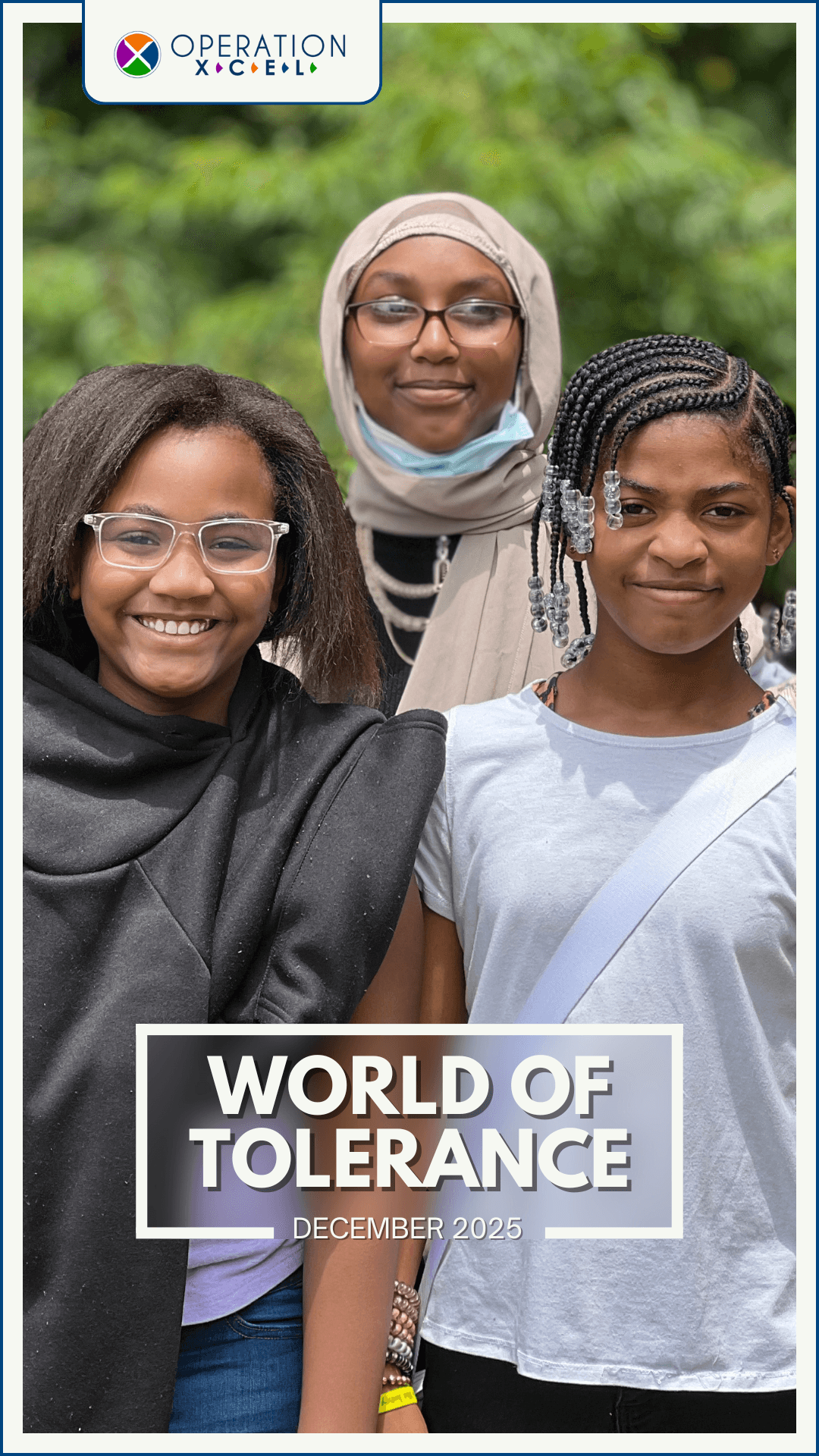
The Foundation of Tolerance
Every day offers us an opportunity to practice tolerance—not just as a response to differences, but as a daily celebration of what makes each of us unique. True tolerance means actively embracing and valuing the many cultures, expressions, and perspectives that enrich our world. This ongoing commitment is at the heart of Operation Xcel’s mission.
We know that the skills of tomorrow’s leaders—from effective teamwork to professional communication in a globalized economy—are rooted in today’s foundational Social-Emotional Learning (SEL). Students who grasp SEL thrive academically and socially, preparing them for future careers that will undoubtedly include a wealth of diversity.
SEL in Action: The Tools for True Tolerance
Tolerance is not a passive state of "putting up with" others; it is an active set of interpersonal competencies. At Operation Xcel, we break these down into three developmental pillars:
1. Beyond Blame: The Psychology of the "I-Message"
In inclusive environments, the goal is to protect the relationship while addressing the conflict. Traditional "You-Messages" (e.g., "You are being rude") often trigger the brain’s fight-or-flight response, leading to defensiveness and exclusion.
By teaching the "I-Message" Formula, we help students move from accusation to vulnerability:
- The Emotion: "I feel [Emotion]..." — Identifies the internal state without attacking the other person.
- The Action: "...when you [Action]..." — Focuses on a specific behavior, not the person’s character or culture.
- The Need: "...because [Reason/Need]." — Clarifies the path to a solution.
The Inclusivity Connection: This allows students from different cultural backgrounds to express their unique boundaries and needs without alienating their peers. It requires students to listen to and consider another person's perspective before responding.
2. The 5-Step Resolution: A Framework for Equity
When conflict arises in a diverse setting, the "majority" view can accidentally silence the "minority" view. Our 5-Step Process is designed to ensure equity of voice:
- Step 1: Cool Off. We teach students to recognize "amygdala hijack"—when emotions take over logic. Inclusion is impossible when the brain is in survival mode.
- Step 2: Share & Listen. This is the "Active Listening" phase. Students must restate what they heard before they are allowed to respond, ensuring different perspectives are truly understood.
- Step 3: Brainstorm "Win-Win" Solutions. We remove the "Zero-Sum" mindset. Students are challenged to find a "third way" that respects both parties’ cultural or personal values.
- Step 4 & 5: Choose, Commit, and Follow Up. This builds the accountability and trust required for any mixed community to survive long-term.
3. Affirmations: Building the Internal Engine of Acceptance
Internalized bias is often the greatest barrier to tolerance. Our daily affirmations act as cognitive re-wiring to move students from passive non-judgment to proactive, intentional acceptance:
- Valuing Uniqueness: When a student repeats, "We come with open minds, willing hearts, and caring souls, & high expectations", they are training their brain to view a difference not as a threat, but as an asset to the group's collective strength.
- Internal Foundation: By regularly affirming their own worth and the worth of their peers, students build the internal resilience necessary to authentically respect what UNESCO calls the many "ways of being human."
From Reaction to Prevention: Dismantling Bullying
Intolerance often manifests as exclusion, mockery, or harassment. While many programs are reactive, Operation Xcel’s SEL framework is proactive. We treat intolerance as a lack of skill, not just a lack of character.
- Replacing Power-Over with Power-With: Bullying is often an attempt to gain social power through exclusion. Collaborative Problem-Solving teaches students that true influence comes from the ability to bring people together.
- Building Empathy through "Active Witnessing": When students use I-Messages, they are forced to humanize the other person. It is much harder to harass someone once you have been required to look them in the eye and acknowledge their specific feelings and needs.
- The "Bystander" Transformation: By fostering a community where "I choose kindness" is a shared daily affirmation, we empower the "silent majority" to become active upstanders. When the collective culture values diversity, the social "reward" for bullying disappears.
A Call to Action
Tolerance is the active choice to respect and appreciate the diversity around us. As the UNESCO Declaration affirms, "only tolerance can ensure the survival of mixed communities in every region of the globe." At Operation Xcel, we are proud to be building this skill set—one conversation, one conflict resolution session, and one powerful affirmation at a time. We are cultivating a generation that doesn't just tolerate differences but celebrates them.
References
- United Nations General Assembly. (1996). Resolution 51/95: Proclamation of 16 November as International Day for Tolerance.
- UNESCO. (1995). Declaration of Principles on Tolerance.
- CASEL. (2024). The CASEL Framework: What is the CASEL Framework?
